Quick answer: The rainbow first appears in Genesis 9:12–17 as the sign of God’s covenant with Noah, promising never to flood the earth again. It reappears later in Ezekiel 1:28 and Revelation 4:3 and 10:1, where it symbolizes God’s glory and presence rather than a repeated covenant. Below are 25+ Bible verses about rainbows, organized by theme, with plain explanations of what each passage actually means.
I’ve noticed that most articles on this topic just list every rainbow reference and call it a day. But the truth is, the rainbow doesn’t mean the exact same thing every time it shows up in Scripture — and treating Genesis 9 and Revelation 4 as interchangeable actually flattens what makes each passage meaningful. This guide keeps that distinction clear.
What Does the Bible Say About Rainbows?
The Bible doesn’t treat the rainbow as decoration. It’s introduced as a deliberate sign — something God points to and assigns meaning to, not something that just happens to look nice after a storm.
- In Genesis 9, the rainbow is the sign of a covenant — God’s promise never to destroy the earth with a flood again
- In Ezekiel 1:28, the rainbow describes the appearance of God’s glory in a vision
- In Revelation 4:3 and 10:1, the rainbow surrounds God’s throne and appears around a mighty angel, again tied to glory and majesty
So there are really two distinct uses here: rainbow as covenant sign (Genesis) and rainbow as visual description of glory (Ezekiel, Revelation). Both are meaningful, but they’re not saying the same thing, and it’s worth keeping that straight rather than blending them into one generic idea.
I think this distinction gets lost a lot because both uses are genuinely beautiful, and it’s tempting to just fold them together into one warm, general “rainbows are hopeful” message. But Scripture is actually more precise than that. Genesis 9 is making a specific legal-sounding promise. Ezekiel and Revelation are doing something closer to poetry — trying to describe a sight so overwhelming that the closest comparison available was a rainbow after rain. Neither one needs to borrow meaning from the other to be powerful.
The rainbow is first mentioned in Genesis 9:13, right after the flood, when God tells Noah:
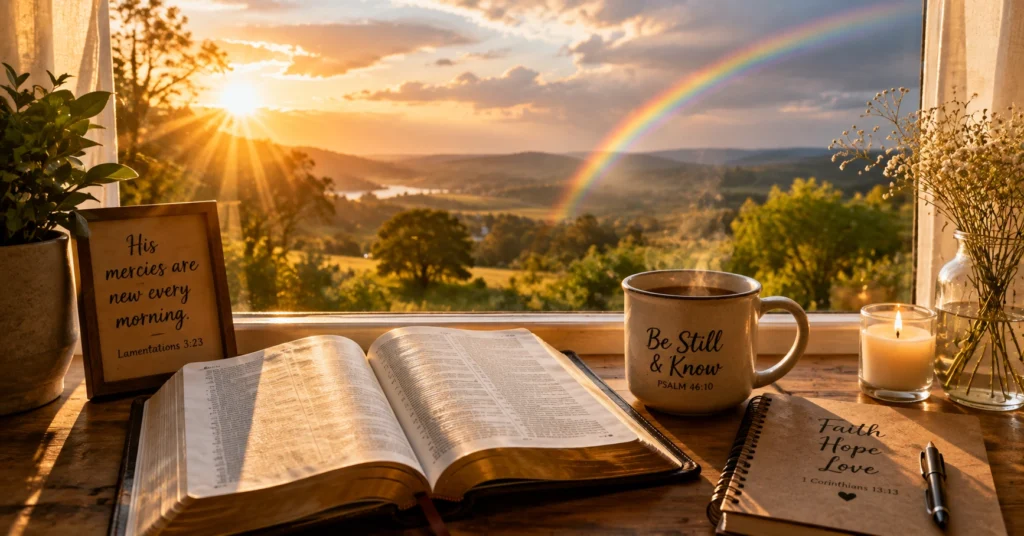
“I have set my bow in the cloud, and it shall be a sign of the covenant between me and the earth.”
This isn’t a passing detail. It’s the first time in Scripture that a physical, visible object is explicitly assigned as a sign of a promise between God and humanity. That’s part of why this passage still gets referenced constantly — it’s the origin point for one of the Bible’s most recognizable symbols.
How Many Times Is a Rainbow Mentioned in the Bible?
- Six times in Genesis 9 (verses 12–17), all part of the same covenant passage
- Once in Ezekiel 1:28, describing the appearance of God’s glory
- Twice in Revelation (4:3 and 10:1), describing the throne room and a mighty angel
That’s fewer than most people assume — around nine total direct references. It’s a small but concentrated set of verses, which is actually part of why each one carries so much weight.
For comparison, a lot of well-known biblical themes — love, faith, fear not — show up hundreds of times across Scripture. The rainbow doesn’t. Its influence on how people think about God’s promises is completely out of proportion to how often it’s actually mentioned, and that’s worth appreciating rather than glossing over. Nine verses have done a lot of theological and cultural work.
Bible Verses About Rainbows
Here are the direct rainbow passages, in order:
- Genesis 9:12 — “This is the sign of the covenant that I make between me and you and every living creature.”
- Genesis 9:13 — “I have set my bow in the cloud, and it shall be a sign of the covenant.”
- Genesis 9:14 — “When I bring clouds over the earth and the bow is seen in the clouds…”
- Genesis 9:15 — “I will remember my covenant… and the waters shall never again become a flood.”
- Genesis 9:16 — “The bow shall be in the cloud, and I will look upon it and remember the everlasting covenant.”
- Genesis 9:17 — “This is the sign of the covenant that I have established between me and all flesh.”
- Ezekiel 1:28 — “Like the appearance of the bow in a cloud on the day of rain… was the appearance of the likeness of the glory of the Lord.”
- Revelation 4:3 — “A rainbow that had the appearance of an emerald encircled the throne.”
- Revelation 10:1 — A mighty angel “wrapped in a cloud, with a rainbow over his head.”
Direct vs. related passages: These nine verses are the only ones that use the word “rainbow” or “bow” in this symbolic sense. Any other verse you see grouped under “rainbow themes” — hope, promise, new beginnings — is thematically related, not a direct rainbow reference. That distinction matters if you’re doing serious Bible study rather than just browsing for encouragement.
The Rainbow in Genesis 9 — God’s Covenant With Noah
Genesis 9 comes right after one of the most devastating events in the Bible — a flood that wiped out nearly everything. Noah and his family step off the ark into a completely reset world, and almost immediately, God makes a promise.
- The covenant is unconditional — it’s not dependent on human behavior
- It’s made with “every living creature,” not just Noah’s family
- The rainbow is described as a sign God Himself will look at and remember
That last point is easy to skim past, but it’s actually one of the more striking details in the passage. God doesn’t just tell Noah to remember the promise — He says He’ll look at the rainbow and remember it Himself. It flips the usual direction of a reminder. This sign isn’t primarily for humans to reassure themselves; it’s described as God’s own reminder of His commitment.
That last point is easy to skim past, but it’s actually one of the more striking details in the passage. God doesn’t just tell Noah to remember the promise — He says He’ll look at the rainbow and remember it Himself. It flips the usual direction of a reminder. This sign isn’t primarily for humans to reassure themselves; it’s described as God’s own reminder of His commitment.
There’s also something worth noticing in the word “bow” itself. In Hebrew, the word used here (qesheth) is the same word used elsewhere in Scripture for a weapon — a hunting or war bow. Some readers connect this to the idea of a bow being “hung up,” pointed away from the earth rather than toward it, as a picture of judgment being set aside. That’s an interpretation rather than something the text states outright, but it’s a detail that adds weight to why this particular object was chosen as the sign.
What Does the Rainbow mean?
- Covenant — a formal, binding promise (Genesis 9:12–17)
- God’s faithfulness — a visible reminder that God keeps His word
- Promise — specifically, the promise never to flood the whole earth again
- Mercy — appearing after judgment, not instead of it
- Hope — a sign that destruction isn’t the final word
- God’s glory — in Ezekiel and Revelation, tied to God’s throne and presence rather than a promise
I’d push back gently on the common habit of treating every one of these meanings as interchangeable. Mercy and covenant are closely related in Genesis 9, sure. But “glory” in Revelation 4 isn’t really about mercy at all — it’s describing what God’s throne room looks like. Both are legitimate, but conflating them muddies what each passage is actually saying.
Rainbow Imagery in Ezekiel and Revelation
- Ezekiel 1:28 — Ezekiel sees a vision of God’s glory, and the closest comparison he can find is the appearance of a rainbow after rain.
- Revelation 4:3 — John sees a rainbow “like an emerald” encircling God’s throne — again, describing appearance and majesty.
- Revelation 10:1 — A powerful angel appears with a rainbow over his head, reinforcing the same association between rainbows and divine glory.
None of these three passages mention a covenant. They’re visionary, symbolic descriptions of what glory looks like — borrowing the rainbow’s beauty and uniqueness to describe something otherwise hard to put into words.
It’s worth pointing out how both Ezekiel and John reach for the same comparison independently, centuries apart. Neither of them is describing an ordinary weather event — they’re trying to put a vision of God’s throne room into human language, and both land on the rainbow as the closest available image.
Old Testament vs. New Testament Rainbow Imagery
- Old Testament (Genesis 9): Rainbow as covenant — a promise tied to a specific historical event (the flood) and a specific commitment (never again).
- Old Testament (Ezekiel 1:28): Rainbow as visual language for God’s glory in a prophetic vision.
- New Testament (Revelation 4:3, 10:1): Rainbow imagery continues the “glory” association from Ezekiel, appearing around God’s throne and a heavenly figure.
Interestingly, the New Testament doesn’t return to the covenant use of the rainbow at all — it builds entirely on the Ezekiel pattern. That’s a detail worth knowing if you’ve ever wondered why Revelation’s rainbow doesn’t come with a “never again” promise attached to it. It’s not making a new covenant claim; it’s continuing a different thread of the symbol.
This is one of those small observations that changes how you read Revelation 4 once you notice it. John isn’t reintroducing the Noah story. He’s using an image his readers already associated with divine glory, thanks to Ezekiel, and placing it around God’s throne to communicate majesty rather than promise. Same symbol, different job.
Bible Verses About Rainbows by Theme
- Promises: Genesis 9:11, Genesis 9:15
- Hope: Genesis 9:16, Lamentations 3:22–23 (related theme, not a direct rainbow verse)
- Faithfulness: Genesis 9:15, Lamentations 3:23
- New beginnings: Genesis 9:1, Genesis 8:20–22 (post-flood context)
- Difficult times: Genesis 9:14 (the bow appears specifically “when clouds” gather)
- God’s glory: Ezekiel 1:28, Revelation 4:3
- Encouragement: Genesis 9:13, Revelation 10:1
Notice that a few of these are marked as related rather than direct. That’s intentional — grouping every “hope” or “new beginning” verse under “rainbow verses” is a common shortcut, but it can blur what Scripture is literally saying versus what a theme reasonably connects to.
Rainbow Verses for Hope After the Storm
There’s something almost poetic about the placement of Genesis 9. The rainbow doesn’t appear before the flood, or during it. It shows up after — once the water has receded and the world is starting over.
- The rainbow only appears “when clouds are over the earth” (Genesis 9:14) — meaning the sign is specifically tied to moments that could look threatening
- It’s a promise attached to exactly the kind of weather that might otherwise cause fear
- The timing itself carries a message: the sign of hope shows up in the middle of what looks like trouble, not just after it’s completely gone
If you’ve ever felt like your own “storm” wasn’t quite over yet, this detail is worth sitting with. The rainbow in Genesis 9 isn’t a symbol that only appears once life is calm again — it’s built into the storm clouds themselves.
I find this one of the more comforting details in the whole passage, honestly. It would have been easy for the text to describe the rainbow appearing only after the sky had fully cleared — a tidy, after-the-fact symbol. Instead, the promise is written directly into the conditions that would normally cause worry. The clouds aren’t the enemy of the sign; they’re the setting for it.
Bible Verses About New Beginnings
Genesis 9 sits inside a larger “starting over” narrative:
- Genesis 8:20–22 — Noah builds an altar, and God promises that seasons, day and night, will continue without interruption
- Genesis 9:1 — God tells Noah and his sons to “be fruitful and multiply,” echoing the original creation command
- Genesis 9:12–17 — The rainbow covenant seals this new beginning with a visible, lasting sign
Reading these together, the rainbow isn’t a standalone image — it’s the closing piece of a much bigger reset. The flood ends, life resumes, and the rainbow becomes the marker that says: this is real, this is settled, this isn’t going to happen again.
How Can a Rainbow Remind Us of God’s Faithfulness?
- It’s a visible sign, not just a verbal promise — something you can actually see, not something you have to take entirely on memory
- It appears repeatedly, not once — every time conditions are right, the same reminder shows up again
- It’s described as God’s own reminder — Genesis 9:16 says God will look at it and remember, which reframes the whole symbol
Practically speaking, a lot of people find it meaningful to notice a rainbow and let it be a small, physical reminder that God’s promises don’t expire. That’s a reasonable and healthy way to engage with the symbol — as a personal reminder, not as a coded message.
Biblical Rainbow Meaning vs. Modern Symbolism
This is worth addressing directly, because it’s an area where a lot of confusion happens.
- Biblically, the rainbow’s meaning is specific and stated outright: it’s the sign of God’s covenant with Noah (Genesis 9), and separately, a description of divine glory (Ezekiel, Revelation)
- Scripture doesn’t comment on or address these modern uses at all, since they didn’t exist when these passages were written
The honest, accurate approach here is to explain what the biblical text says on its own terms, without trying to force it into a reaction to modern symbolism it was never written to address. Genesis 9 is about a flood and a covenant — full stop. Reading contemporary associations back into an ancient text (in either direction) tends to create more confusion than clarity.
How Should Christians Respond When They See a Rainbow?
- Let it be a reminder, not a message — Genesis 9 doesn’t suggest every rainbow is a personal sign meant just for you; it’s a general reminder of a general promise
- Use it as a prompt for gratitude — a simple, natural moment to remember God’s faithfulness
- Avoid over-interpreting — Scripture doesn’t describe rainbows as carrying hidden or specific personal messages
- Enjoy it — there’s nothing wrong with simply appreciating something beautiful without assigning deep spiritual weight to every instance
This is a place where restraint actually serves people better than enthusiasm. The rainbow’s meaning in Genesis 9 is broad and universal — a promise to “every living creature,” not a signal meant to be decoded individually.
Short Rainbow Bible Verses to Share
- “I have set my bow in the cloud.” — Genesis 9:13
- “The bow shall be in the cloud.” — Genesis 9:16
- “This is the sign of the covenant.” — Genesis 9:12
- “A rainbow… encircled the throne.” — Revelation 4:3
Short, quotable verses like these work well for a quick text, caption, or note — simple enough to remember, and accurate to what the passage actually says.
Morning Reflection: Remembering God’s Promises
Scripture: “I have set my bow in the cloud, and it shall be a sign of the covenant between me and the earth.” — Genesis 9:13
Mornings have a way of resetting things, even when nothing about the actual situation has changed overnight. That’s part of why this verse fits well as a morning reflection — it’s a passage about a fresh start following something genuinely difficult.
Before the day gets going, it’s worth remembering: whatever storm you’re walking through right now, the biblical pattern is that promises outlast the flood. The water recedes. The sign remains.
Morning Prayer Inspired by Scripture
God, thank You for being a promise-keeper, even when I can’t see the full picture yet. Just as You set the rainbow as a reminder after the flood, help me remember Your faithfulness today — in the ordinary moments and the hard ones. Where I’m anxious, remind me that You see the whole storm and You’ve already made a promise about how it ends. Amen.
Evening Reflection: Trusting God After the Storm
Scripture: “When I bring clouds over the earth and the bow is seen in the clouds, I will remember my covenant.” — Genesis 9:14–15
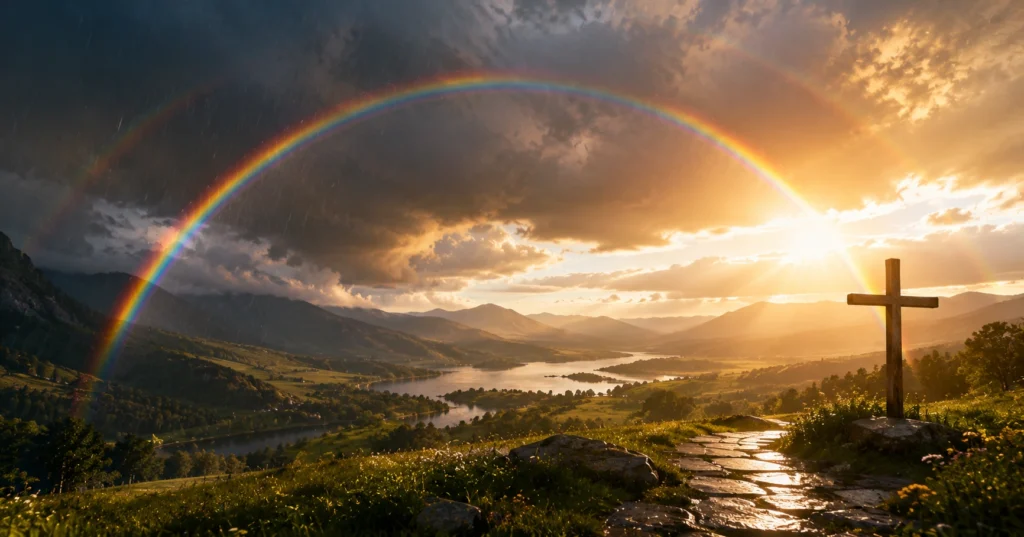
Evenings tend to bring a different kind of reflection than mornings — less about starting fresh, more about looking back over the day that’s just ended. This verse fits that mood well, because it’s specifically about what happens during clouds, not just after they clear.
If today felt heavy, this passage offers something honest rather than falsely cheerful: the sign of the promise shows up exactly when the clouds are still there. You don’t have to wait for the sky to be completely clear to trust that the promise still holds.
Evening/Sunset Prayer
Lord, as this day ends, thank You for staying faithful through it — even the parts that felt cloudy or uncertain. Help me rest tonight, trusting that You remember Your promises even when I can’t see past the clouds. Renew my hope for tomorrow, the way the rainbow renews the sky after rain. Amen.
Rainbow Bible Study Guide
Scripture reading:
- Genesis 9:8–17 (the full covenant passage)
- Ezekiel 1:26–28 (rainbow as glory)
- Revelation 4:1–3 (rainbow around the throne)
Reflection questions:
- What was happening right before God gave Noah this promise?
- Why do you think God chose something visible, like a rainbow, as the sign?
- What’s the difference between how Genesis and Revelation use rainbow imagery?
- Have you experienced a “rainbow moment” — a reminder of God’s faithfulness after a hard season?
Application questions:
- How can you respond to reminders of God’s faithfulness without over-interpreting them?
- Is there a “flood” in your own life you’re still waiting to see the other side of?
Quick Reference — Rainbow Bible Verses by Theme
| Theme | Key Verses |
|---|---|
| Covenant | Genesis 9:12–17 |
| God’s Glory | Ezekiel 1:28; Revelation 4:3 |
| Hope | Genesis 9:13, 16 |
| Faithfulness | Genesis 9:15 |
| New Beginnings | Genesis 8:20–22; Genesis 9:1 |
| Mercy | Genesis 9:11, 15 |
| Majesty | Revelation 10:1 |
Frequently Asked Questions
What does the rainbow mean in the Bible? Primarily, it’s the sign of God’s covenant with Noah in Genesis 9 — a promise never to flood the whole earth again. Separately, in Ezekiel and Revelation, it describes the appearance of God’s glory.
How many times is a rainbow mentioned in the Bible? About nine times total — six in Genesis 9, once in Ezekiel 1:28, and twice in Revelation (4:3 and 10:1).
Is the rainbow always about God’s promise in Scripture? No. Genesis 9 is explicitly covenant-related, but Ezekiel 1:28 and Revelation 4:3 use rainbow imagery to describe God’s glory, not a repeated promise.
What is the difference between the biblical rainbow and modern rainbow symbolism? The Bible defines the rainbow specifically as a covenant sign and a description of divine glory. Modern cultural uses of the rainbow developed separately and aren’t addressed anywhere in Scripture.
Does every rainbow mean something personal? Scripture doesn’t suggest that. Genesis 9 presents the rainbow as a general, universal reminder — not a coded or individualized message.
What Bible verse is best for a rainbow devotional? Genesis 9:13 is the most commonly used, since it’s the origin verse and captures both the promise and the visible sign in one line.
Conclusion
The rainbow’s biblical meaning is more specific — and more interesting — than a lot of surface-level explanations give it credit for. It starts as a covenant sign after the flood, tied to a very particular promise. Later, it becomes shorthand for describing something almost indescribable: the appearance of God’s own glory.
Both uses point to the same underlying idea, even if they’re not identical: something beautiful, consistent, and reliable, showing up exactly where you might expect only storm clouds. Whatever season you’re walking through, that pattern is worth remembering — the rainbow was never meant to replace the clouds. It was placed right inside them.