Quick answer: The Bible mentions stars over 40 times — and they almost always point back to God. Stars show up as proof of His creative power (Genesis 1:16, Psalm 19:1), as a picture of His promises (Genesis 15:5), as symbols of wisdom and righteousness (Daniel 12:3), and even as a title for Jesus Himself, the “bright and morning star” (Revelation 22:16). Some references are literal — actual stars in the sky. Others are symbolic — stars standing in for people, angels, or spiritual truths. Below, you’ll find all 50 verses organized by theme, with the context and meaning behind each one, plus a devotional, a prayer, and a study guide you can actually use.
I still remember the first time I looked up at a genuinely dark sky, far from any city — thousands of stars, more than I could count. It’s easy to see why Scripture keeps coming back to them. They’re the go-to image for something too vast to measure: God’s power, His promises, His knowledge of us.
What Does the Bible Say About Stars?
Short answer: stars are part of God’s creation, and Scripture uses them constantly to describe who He is.
A few things come up again and again:
- Stars were made by God, on purpose, on day four of creation (Genesis 1:14–18) — not random, not accidental.
- The heavens themselves preach a wordless sermon about God’s glory (Psalm 19:1).
- God used a starry sky as a promise to Abraham that his descendants would be too many to count (Genesis 15:5).
- Stars appear in prophecy, sometimes literally, sometimes as symbols of judgment or upheaval.
- Jesus is directly connected to star imagery — He’s called the Morning Star, and a star announced His birth.
The one thing to keep in mind as you read through these verses about stars in the Bible: context decides whether a passage is talking about a literal star in the sky or using “star” as a symbol for something else — a person, a nation, an angel, an era. Both uses are common, and mixing them up is where a lot of surface-level Bible study goes wrong.
What Do Stars Symbolize in the Bible?
Stars don’t carry one fixed meaning cover to cover. The symbolism shifts depending on where you are in the story.
Stars as a Picture of God’s Creation
The most basic use: stars exist because God spoke them into being. They’re evidence, not decoration (Psalm 33:6, Psalm 8:3–4).
Stars and God’s Glory
David couldn’t look at the night sky without writing about it. Psalm 19:1 says the heavens “declare the glory of God” — stars are a kind of silent worship.
Stars and God’s Sovereignty
Isaiah 40:26 makes the point that God names every star individually. If He knows each star by name, the implication for how He knows you isn’t subtle.
Stars as a Picture of Abraham’s Descendants
God didn’t just promise Abraham a big family — He pointed at the sky and said, “count them if you can” (Genesis 15:5). It’s one of the most personal, visual promises in Scripture.
Stars and Wisdom
Daniel 12:3 compares the wise, and those who lead others to righteousness, to stars that “shine forever.” Wisdom here isn’t abstract — it’s something that gives off light for other people to see by.
Stars and Righteousness
Closely tied to wisdom: living rightly is pictured as light-giving, the same way a star cuts through darkness.
Stars and Heavenly Beings
In places like Revelation 1:20 and Job 38:7, “stars” function as a stand-in for angels or spiritual beings — a literary device, not a claim that angels are literally balls of gas.
Stars in Prophetic Imagery
Stars “falling from heaven” shows up in Jesus’s Olivet Discourse and in Revelation — dramatic, symbolic language for cosmic upheaval and judgment, common in Jewish apocalyptic writing.
The Morning Star and Jesus
Jesus applies the title “morning star” to Himself in Revelation 22:16. It’s the brightest star, the one that signals night is ending — a fitting picture of what He claims to be for the world.
The rule of thumb worth repeating: when a passage is describing creation, take it literally. When it’s poetry, prophecy, or apocalyptic writing, expect symbolism.
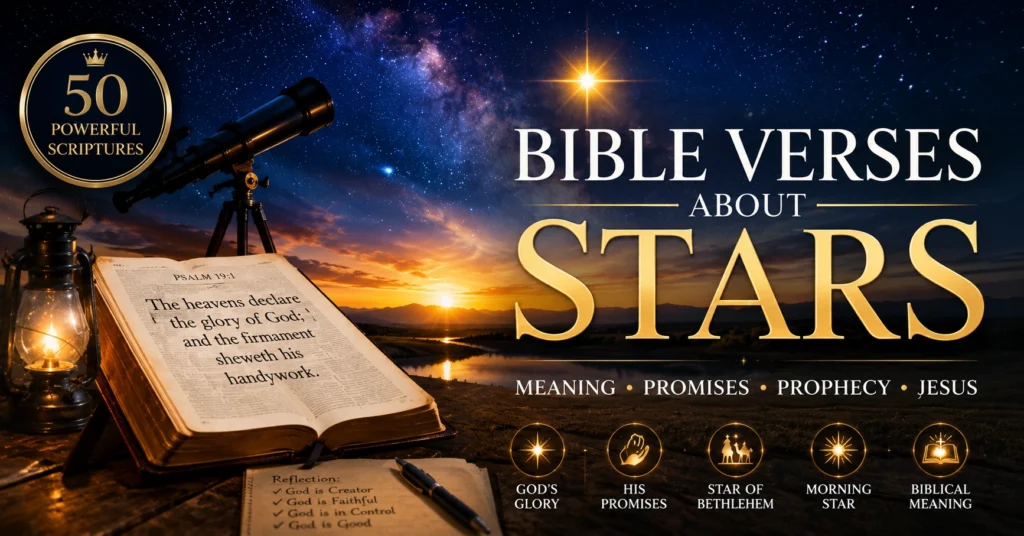
50 Bible Verses About Stars
Here’s the full collection, grouped by theme so you can actually find what you’re looking for instead of scrolling through a random list.
Bible Verses About Stars and Creation
- Genesis 1:14–18 — God creates the sun, moon, and stars to mark seasons, days, and years.
- Psalm 8:3–4 — “When I consider thy heavens… what is man, that thou art mindful of him?”
- Psalm 19:1 — “The heavens declare the glory of God.”
- Psalm 33:6 — “By the word of the LORD were the heavens made… all the host of them by the breath of his mouth.”
- Psalm 136:9 — God made “the moon and stars to rule by night.”
- Job 38:7 — The morning stars sang together at creation.
Context & meaning: These aren’t scattered references — they’re a consistent thread. From Genesis to Job to the Psalms, the stars are treated as intentional, ordered, spoken into existence. Application: Next clear night, step outside and actually look up. It’s one of the simplest ways to put these verses into practice.
Bible Verses About Stars and God’s Glory
- Psalm 19:2–4 — The heavens’ “voice” reaches every corner of the earth.
- Isaiah 40:26 — “Lift up your eyes on high, and behold who hath created these things.”
- Psalm 147:4 — God “telleth the number of the stars; he calleth them all by their names.”
- Nehemiah 9:6 — God alone made “heaven, the heaven of heavens, with all their host.”
- Amos 5:8 — God “maketh the seven stars and Orion.”
Psalm 147:4 says God does this for every star. Application: If God tracks stars by name, that’s worth sitting with the next time you feel like a number.
Bible Verses About Stars and Abraham’s Descendants
- Genesis 15:5 — “Look now toward heaven, and tell the stars… So shall thy seed be.”
- Genesis 22:17 — God repeats the promise after Abraham’s test of faith with Isaac.
- Genesis 26:4 — The promise is passed down to Isaac.
Context & meaning: This wasn’t a vague blessing — it was a specific, visual, unforgettable image tied to a covenant. Abraham had no children yet when God said this. Application: God’s promises sometimes ask you to wait a long time before you see them fulfilled. Abraham’s story is proof that the wait doesn’t mean the promise was empty.
Bible Verses About the Star of Jacob
- Numbers 24:17 — Balaam’s prophecy: “There shall come a Star out of Jacob.”
Context & meaning: Balaam, a pagan prophet hired to curse Israel, ends up prophesying instead — pointing to a future ruler symbolized by a star. Many scholars connect this to a messianic prophecy, later echoed at Christ’s birth. Application: Even prophecy from an unlikely source can carry real weight. Pay attention to where truth shows up, not just who’s saying it.
The Star of Bethlehem: What Does the Bible Say?
Direct answer: Matthew 2:1–12 is the only place this story is told, and it’s shorter than most people assume — there’s a lot Scripture simply doesn’t tell us.
What Matthew 2:1–12 Says About the Star
Wise men (“Magi”) from the East see a star and travel to Jerusalem, asking where the newborn “King of the Jews” is.
Who Were the Magi?
Likely astrologers or scholars from Persia or Babylon — not kings, and the Bible never says there were exactly three.
What Did the Star Do?
It “went before them” and “stood over where the young child was” (Matthew 2:9).
Why Did the Magi Follow It?
They interpreted it as a sign of a significant royal birth, based on ancient astronomical and prophetic traditions.
What We Actually Know vs. What We Don’t
Here’s the honest bullet-point breakdown:
- We know: the Magi saw something in the sky, they connected it to a king’s birth, and it led them to Jesus.
- We don’t know: exactly what the star was, how many Magi there were, or precisely when they arrived (likely up to two years after Jesus’s birth, based on Herod’s later actions).
Historical and Astronomical Theories
Some suggest a planetary conjunction, a comet, or a supernova. Others see it as a supernatural sign that doesn’t map onto any known astronomical event. The text itself leans toward something beyond ordinary — a star that moves and stops isn’t how celestial bodies normally behave.
Jesus as the Morning Star
Revelation 22:16 — Jesus calls Himself “the bright and morning star,” one of the final self-descriptions He gives in Scripture.
2 Peter 1:19 — Peter tells believers to pay attention to prophecy “until the day dawn, and the day star arise in your hearts.”
Why “Morning Star”? The morning star is the last light visible before sunrise — it doesn’t just shine in the dark, it announces that darkness is ending. That’s the picture: Jesus isn’t just a light among many, He’s the sign that everything is about to change.
Morning Star vs. Ordinary Stars Every other star in Scripture points to something else — God’s power, His promises, His people. This is the one place a star is the subject, not a symbol pointing away from itself.
What Does the Bible Say About Stars and Angels?
Short answer: sometimes “stars” means angels, but not always — context is everything.
- Revelation 1:20 — the seven stars in John’s vision are directly explained as “the angels of the seven churches.”
- Job 38:7 — “morning stars” sing together at creation, paired with “sons of God,” widely understood as angelic beings.
- Why you shouldn’t assume every star = angel: most star references in the Bible are literal or refer to people, promises, or creation. Only read “star” as angel when the passage itself makes that connection explicit, like Revelation does.
Bible Verses About Stars and Wisdom
Daniel 12:3 — “They that be wise shall shine as the brightness of the firmament; and they that turn many to righteousness as the stars for ever and ever.”
This verse ties wisdom directly to influence — not just knowing the right thing, but helping other people find it too. Living wisely isn’t private; like a star, it’s visible.
- Wisdom is pictured as light, not information.
- Righteousness is pictured as something that spreads, the way starlight reaches places the star itself never touches.
- The reward language (“for ever and ever”) ties this to eternal significance, not just earthly reputation.
Bible Verses About Stars and Guidance
Did stars ever function as guidance in Scripture? Yes — but with an important distinction.
- The Magi followed a star to find Jesus (Matthew 2:9–10) — a one-time, supernatural sign, not a repeatable method.
- Psalm 32:8 and similar verses show God’s normal pattern of guidance is through His presence and His word, not the night sky.
- The Bible consistently separates God using a star as a sign in a specific narrative from humans seeking guidance from the stars themselves (astrology) — the second one gets warned against repeatedly.
If you’re looking for a takeaway here: God can use creation to point people toward Him, but Scripture never tells us to look to the stars for direction the way the Magi did. That was a one-time event, not a template.
Stars in Biblical Prophecy
Stars Falling From Heaven
Jesus describes “the stars shall fall from heaven” as part of end-times imagery (Matthew 24:29) — apocalyptic language for cosmic disruption tied to judgment.
Isaiah’s Star Imagery
Isaiah 13:10 uses darkened stars to picture God’s judgment on Babylon — the language is bigger than the historical event, which is typical of prophetic writing.
Stars in Revelation
Revelation 6:13, 8:10–12, and 12:1–4 all use dramatic star imagery — falling stars, a woman “clothed with the sun” and crowned with twelve stars, a dragon sweeping a third of the stars from the sky.
How Should We Interpret Prophetic Star Imagery?
- Treat it as symbolic unless context clearly demands otherwise.
- Don’t build specific date predictions on it — that’s a pattern Scripture itself warns against (Matthew 24:36).
- Read it for the message (God’s judgment, God’s ultimate authority over creation) rather than mining it for a timeline.
Do Stars Represent People in the Bible?
Yes, in several places:
- Daniel 12:3 — the wise and righteous are compared to shining stars.
- Philippians 2:15 — believers are told to “shine as lights in the world.”
- Revelation 1:20 — stars represent specific church leaders/messengers.
The pattern: when stars represent people, it’s almost always about visible influence — living in a way that gives off light other people can actually see and follow.
Does the Bible Support Astrology?
Direct answer: no. Scripture repeatedly separates admiring the stars as God’s creation from looking to the stars for guidance or power.
- Stars are part of God’s creation — worth wonder, not worship (Genesis 1:16).
- The Bible’s warnings about worshiping heavenly bodies appear clearly in Deuteronomy 4:19 and 17:3 — God specifically forbids worshiping sun, moon, or stars.
- Astrology and divination are grouped with other forbidden practices in Isaiah 47:13–14 and Deuteronomy 18:10–12.
- What Scripture actually teaches: stars reveal the Creator’s power; they were never meant to predict or control your future.
- Creation vs. divination — the real difference: looking at the stars and thinking “God is powerful” is worship. Looking at the stars to figure out what will happen to you is exactly what the Bible says not to do.
Bible Verses About Worshiping Stars and Idolatry
- Deuteronomy 4:19 — a direct warning against being drawn to worship “the sun, and the moon, and the stars.”
- Deuteronomy 17:2–5 — worshiping the sun, moon, or “host of heaven” is treated as a serious covenant violation.
- Jeremiah 19:13 — describes rooftops used for burning incense “unto all the host of heaven.”
- Zephaniah 1:5 — condemns those who worship “the host of heaven upon the housetops.”
The consistent message: creation is meant to point toward God, not replace Him.
Short Bible Verses About Stars
For when you just want something quick to read or memorize:
| Verse | Main Message |
|---|---|
| Psalm 19:1 | God’s glory |
| Psalm 147:4 | God’s knowledge |
| Genesis 15:5 | God’s promise |
| Daniel 12:3 | Righteousness |
| Revelation 22:16 | Jesus, the Morning Star |
| Job 38:7 | Creation’s joy |
| Amos 5:8 | God’s power over the heavens |
Most Encouraging Bible Verses About Stars
- Psalm 147:4 — proof God tracks details most people would never notice.
- Genesis 15:5 — a promise made real, in the sky, when Abraham had every reason to doubt.
- Isaiah 40:26 — a reminder to “lift up your eyes” when life feels small.
- Daniel 12:3 — your influence can outlast you.
- Revelation 22:16 — Jesus identifies with the very image of hope breaking through darkness.
Bible Verses About Stars and God’s Promises
Genesis 15:5 is the anchor verse here. God didn’t just tell Abraham he’d have descendants — He took him outside, pointed up, and said “try counting those.”
- The promise was visual, not vague.
- Abraham’s faith is credited to him as righteousness immediately after this moment (Genesis 15:6) — the star promise and Abraham’s faith are directly linked in the text.
- The imagery gets repeated at least three times (Genesis 15:5, 22:17, 26:4), reinforcing that this wasn’t a one-off encouragement but a defining covenant.
What Can Stars Teach Us About God?
God Is Greater Than His Creation
If the stars are this vast and He made them casually (“by the word of the LORD,” Psalm 33:6), that tells you something about scale.
God Knows Every Star
Not generally — by name (Psalm 147:4). That’s not poetic exaggeration; it’s the whole point of the verse.
God’s Promises Are Worth Trusting
Abraham waited decades. The stars were the reminder, not the fulfillment.
Creation Can Lead Us to Worship
Psalm 19 moves from “the heavens declare” straight into praise — looking up is meant to lead somewhere.
We Are Called to Reflect God’s Light
Daniel 12:3 and Philippians 2:15 both push the same idea: don’t just admire the light, become part of it.
A Short Devotional on Stars and God’s Glory
Scripture: “The heavens declare the glory of God; and the firmament sheweth his handywork.” — Psalm 19:1
Reflection: There’s something about a genuinely dark, star-filled sky that makes small talk feel pointless. You just look. That instinct — quiet, a little humbled — might be exactly what this verse is describing.
What It Means: David isn’t making an argument for God’s existence here. He’s describing an experience — creation doesn’t need words to communicate something true about who made it.
How to Apply It Today:
- Step outside tonight, even for two minutes, and actually look up.
- Notice the instinct to feel small — sit with it instead of brushing past it.
- Let it turn into a short, honest prayer rather than just a nice moment.
Short Prayer: Lord, the same hands that scattered the stars know my name. Help me trust You with the things I can’t see the end of yet. Amen.
A Prayer Inspired by the Stars
Father, You spoke and the stars appeared — more than I could ever count, each one known to You by name. If You hold the universe together and still know the details of my life, I don’t need to carry my worries alone. Like Abraham looking up at a sky full of promises he couldn’t yet see fulfilled, help me trust You while I wait. Guide me the way You guided the wise men — not to a spectacle, but to Jesus, the true Morning Star. Let my life reflect a little of that light to the people around me. Amen.
Bible Study Guide: Stars in Scripture
- Read the passage in full — don’t isolate a single verse from its surrounding context.
- Observe the context — Is this poetry? Prophecy? Historical narrative? That shapes everything.
- Identify literal vs. symbolic language — ask directly: is this describing an actual star, or using “star” as an image for something else?
- Compare related Scriptures — cross-reference other star passages to see how the theme develops.
- Ask what the passage reveals about God — His power, His knowledge, His promises, His character.
- Apply the lesson — write down one concrete way this changes how you think or act this week.
Reflection Questions About Stars in the Bible
- What does creation reveal about God’s character, based on what you’ve read here?
- Which Bible verse about stars speaks to you most right now — and why?
- What does Psalm 19 teach about God’s glory that you hadn’t noticed before?
- What can Abraham’s story teach you about waiting on a promise?
- How does Jesus being called the Morning Star change how you think about hope?
- Are there areas where you’re tempted to look for guidance in the wrong places?
- What does the night sky remind you about God’s greatness?
Quick-Reference Table — Bible Verses About Stars by Theme
| Theme | Bible Verse |
|---|---|
| God’s creation | Genesis 1:16 |
| God’s glory | Psalm 19:1 |
| Abraham’s descendants | Genesis 15:5 |
| God’s knowledge | Psalm 147:4 |
| Wisdom | Daniel 12:3 |
| Star of Jacob | Numbers 24:17 |
| Star of Bethlehem | Matthew 2:2 |
| Jesus as Morning Star | Revelation 22:16 |
| Stars and angels | Revelation 1:20 |
| Prophecy | Matthew 24:29 |
| Warning against star worship | Deuteronomy 4:19 |
Frequently Asked Questions About Stars in the Bible
What does the Bible say about stars? Stars are part of God’s creation, made on day four (Genesis 1:14–18), and Scripture uses them repeatedly to point to God’s power, glory, and promises.
What do stars symbolize in the Bible? Depending on context: God’s creative power, His promises (to Abraham), wisdom and righteousness (Daniel 12:3), angels (Revelation 1:20), or Jesus Himself (Revelation 22:16).
What is the most famous Bible verse about stars? Genesis 15:5 and Psalm 19:1 are the two most quoted — one about God’s promise, one about His glory.
What Bible verse says God knows the stars by name? Psalm 147:4 — “He telleth the number of the stars; he calleth them all by their names.”
What was the Star of Bethlehem? Matthew 2:1–12 records that it led the Magi to Jesus, but the Bible doesn’t specify what it physically was — theories range from a supernatural sign to a rare astronomical event.
Is Jesus called the Morning Star? Yes — in Revelation 22:16, Jesus directly calls Himself “the bright and morning star.”
Does the Bible support astrology? No. Scripture consistently warns against seeking guidance from the stars (Deuteronomy 4:19, Isaiah 47:13–14), while still affirming that the stars themselves are part of God’s good creation.
Related Bible Topics to Explore
- Bible verses about the moon
- Bible verses about the sun
- Bible verses about light
- Bible verses about heaven
- Bible verses about God’s creation
- Bible verses about God’s glory
- Bible verses about hope
- Bible verses about faith
- Bible verses about God’s promises
- Bible verses about guidance
- Bible verses about angels
- Bible verses about Jesus
- Bible verses about prophecy
Conclusion
Stars in Scripture are more than beautiful objects in the night sky. They reveal God’s creative power, point toward His glory, appear woven into His promises and prophetic imagery, and ultimately connect to the story of Christ — the Bright Morning Star. The next time you catch a clear night sky, let it do what it’s done for believers for thousands of years: turn wonder into worship, and worship into trust.