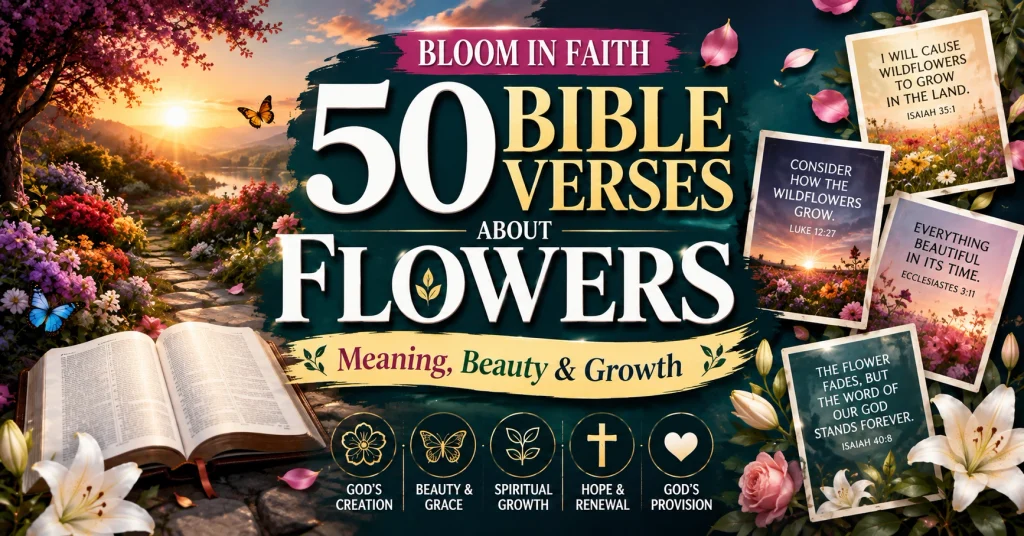
The Bible uses flowers to teach about God’s creativity, His provision, spiritual growth, and the shortness of human life. From the lilies of the field to the Rose of Sharon, flowers show up again and again as a picture of beauty that fades — and a reminder to trust the One who made it in the first place.
If you’ve ever stood in a garden and felt something bigger than yourself, Scripture backs that instinct up. A few things flowers point to in the Bible:
- God’s creativity and attention to detail
- His provision, even for things that don’t work for it
- Spiritual growth that happens slowly, mostly out of sight
- Renewal after a season that looked finished
- How short and beautiful human life actually is
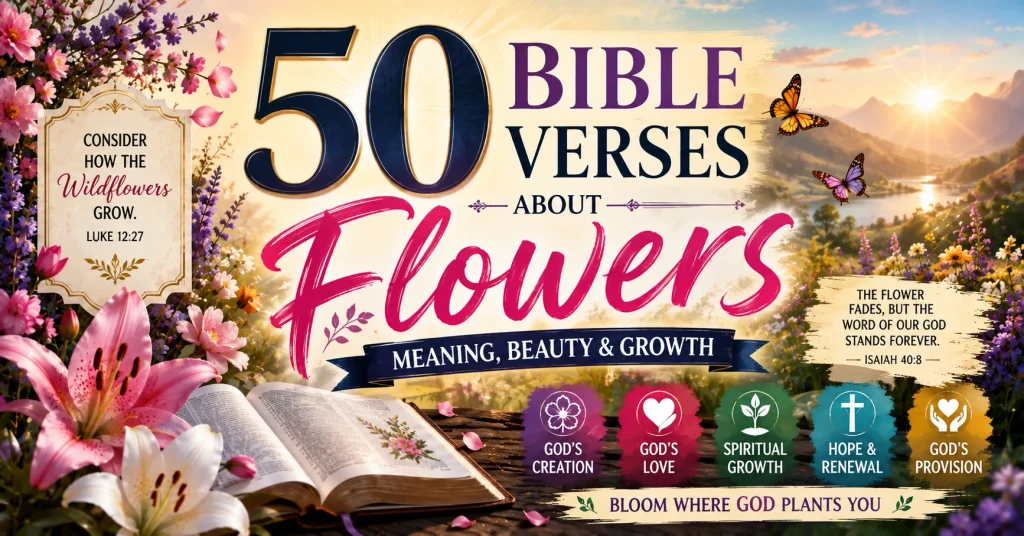
Jesus pointed to flowers when He talked about worry. Solomon used them to describe love. The prophets used them to describe both hope and heartbreak. This article gathers 50 Bible verses about flowers, organized by theme, so you can find exactly what you’re looking for — whether that’s a verse about blooming and new beginnings, one about God’s provision, or something to sit with during a season that feels like it’s fading.
What Does the Bible Say About Flowers?
Direct answer: The Bible uses flowers to point to God’s creation, His beauty, His provision, and the fact that life — like a flower — is temporary and meant to be lived with that in mind.
Flowers show up in Scripture in a few consistent ways:
- As proof of God’s creativity — something beautiful made simply because God wanted it that way
- As a picture of provision — if God dresses a wildflower this well, He hasn’t forgotten you
- As a symbol of growth — planted, watered, and given time before it blooms
- As a picture of renewal — deserts blooming again after a dry season
- As a reminder of how short life is — beautiful one day, gone the next
The same flower can represent beauty in one verse and mortality in another — and honestly, that tension is kind of the point. Something can be fragile and still be worth noticing.
50 Bible Verses About Flowers
Here’s the full collection, organized into themes so it’s easy to find what speaks to your situation right now.
Bible Verses About Flowers and God’s Creation
- Genesis 1:11–12 — God commands the land to produce vegetation, plants, and trees, each bearing seed according to its kind — and He calls it good.
- Psalm 104:24 — The psalmist marvels at how many and how varied God’s works are, all made with wisdom.
- Luke 12:27 — Jesus points to how the wildflowers grow, not through labor or effort, yet not even Solomon in his splendor was dressed as beautifully.
- Matthew 6:28–30 — Jesus tells His listeners to consider the lilies of the field, which don’t work or spin thread, yet are clothed more gloriously than Solomon.
What strikes me here is that God didn’t need flowers to sustain human life the way He needed grain or water. He made them anyway — just because beauty mattered to Him. There’s something worth noticing in the order of Genesis 1, too: vegetation comes before animals, before humans. Flowers were already blooming in a world with no one around to admire them yet. Beauty in Scripture doesn’t only exist for an audience.
Bible Verses About Flowers and Beauty
- Song of Solomon 2:1 — The speaker describes herself as a rose of Sharon and a lily of the valleys.
- Song of Solomon 2:2 — Among thorns, she is compared to a lily among young women.
- Song of Solomon 5:13 — Lips are compared to lilies, dripping with liquid myrrh.
- Song of Solomon 6:2–3 — Garden and lily imagery is used to describe closeness and belonging.
- Luke 12:27 — Jesus again references the wildflowers as more beautifully dressed than royalty.
Beauty in Scripture isn’t treated as shallow or unimportant. It’s part of how God expresses love, care, and creativity — in gardens, in relationships, and in creation itself. Song of Solomon is often the most surprising book for people to discover this in — it’s unapologetically about romantic love and physical beauty, using flower imagery without any hint of embarrassment. That alone says something: Scripture doesn’t treat beauty as a distraction from spiritual things. It treats it as one of the ways spiritual things get expressed.
Bible Verses About Flowers Blooming
- Song of Solomon 2:12 — Flowers appear on the earth, the season of singing has come.
- Isaiah 35:1–2 — The desert and dry land will be glad, and the wilderness will rejoice and blossom.
- Hosea 14:5–7 — God promises His people will blossom like a lily, take root like the cedars of Lebanon, and flourish like a garden.
- Isaiah 55:12–13 — Instead of thorns, cypress trees will grow; instead of briers, myrtle — a sign of restoration.
Blooming in the Bible almost always follows a period of waiting. Nothing blossoms overnight. If you’re in a season that feels dormant right now, this theme is worth sitting with.
Bible Verses About Flowers and Spiritual Growth
- Hosea 14:5–7 — Blossoming, taking root, and flourishing are used together as a picture of spiritual restoration.
- Psalm 1:3 — A person who delights in God’s law is like a tree planted by streams of water, yielding fruit in season.
- Jeremiah 17:7–8 — Those who trust in the Lord are like a tree planted by water, unaffected by heat or drought.
- Mark 4:26–29 — Jesus describes the kingdom of God as seed that grows on its own, day and night, without the farmer fully understanding how.
- 1 Corinthians 3:6–7 — Paul plants, Apollos waters, but God makes it grow.
Spiritual growth, like a plant’s growth, isn’t something you can force by staring at it harder. Roots grow underground, out of sight, long before anything visible shows up above the surface. Mark’s parable about the growing seed captures this well — even the farmer doesn’t fully understand the process, and Jesus doesn’t seem bothered by that. If your own growth feels mysterious or slower than you’d like, that’s not evidence something is wrong. It might just mean the roots are doing their work first.
Bible Verses About Flowers and God’s Provision
- Matthew 6:28–30 — Consider the lilies of the field: they don’t labor or spin, yet God clothes them more beautifully than Solomon; how much more will He care for you.
- Luke 12:27–28 — The same teaching, reminding listeners that if God dresses grass that’s here today and gone tomorrow, He won’t forget His people.
If you’ve been anxious about provision lately, this is the section to slow down on. Notice what Jesus doesn’t say — He doesn’t say the lilies work hard and get rewarded for it. He specifically points out that they don’t labor and don’t spin thread, meaning their beauty isn’t something they earned. If you tend to believe provision is something you have to prove you deserve, this teaching says otherwise.
Bible Verses About Flowers, Hope, and Renewal
- Isaiah 35:1–2 — The wilderness and desert will rejoice and blossom like a rose, bursting into flower.
- Hosea 14:5–7 — God’s promise of blossoming and flourishing after a period of unfaithfulness and consequence.
- Isaiah 55:12–13 — Thorns replaced by cypress, briers replaced by myrtle — a lasting sign that won’t be cut off.
Renewal in Scripture usually comes after something has been stripped bare first. The desert doesn’t bloom because nothing bad happened — it blooms because God brought life back to a place that looked finished. If you’re in a barren season right now, that’s not necessarily evidence God has left. It might just be the part of the story right before the blossom.
Bible Verses About Flowers Fading and the Brevity of Life
- Isaiah 40:6–8 — All flesh is like grass, and its glory like the flower of the field; the grass withers, the flower fades, but God’s word stands forever.
- Psalm 103:15–16 — As for man, his days are like grass; he flourishes like a flower of the field, but the wind passes over it and it’s gone.
- Job 14:1–2 — Man born of woman is few of days, springing up like a flower and withering away.
- James 1:10–11 — The rich will fade away like a wild flower, its beauty destroyed as the sun rises with scorching heat.
- 1 Peter 1:24–25 — All flesh is like grass, its glory like a flower that falls, but the word of the Lord endures forever.
I think this is one of the most honest themes in Scripture, because it doesn’t try to soften the reality. It doesn’t say life is short, so don’t feel sad about it. It just states the fact plainly, side by side with something eternal, and lets the comparison do the work. If you’re grieving how fast time is moving, these verses aren’t meant to minimize that — they’re a reminder that grief over something temporary is proof you were made for something that isn’t.
What Do Flowers Symbolize in the Bible?
Direct answer: Flowers in the Bible don’t carry one single fixed meaning — instead, they symbolize several overlapping ideas depending on the context: beauty, God’s provision, growth, renewal, human mortality, and creation itself.
- Beauty — flowers reflect God’s creativity and attention to detail
- Provision — God’s care extends even to short-lived wildflowers, and by extension, to you
- Growth — flowers model the slow, hidden process of spiritual maturity
- Renewal — blooming after a dry season pictures restoration
- Mortality — fading flowers picture how brief human life actually is
- Fruitfulness — flowers precede fruit, tying them to the idea of a future harvest
It’s less accurate to say “this flower means this one thing” and more accurate to say Scripture uses flowers as a flexible image, chosen for whatever point the writer was making at the time.
What Do Lilies Represent in the Bible?
Direct answer: Lilies in the Bible mostly represent beauty and God’s provision — most famously in Jesus’ teaching about the lilies of the field, which He used to teach people not to worry.
- Matthew 6:28–29 — Jesus tells His listeners to consider how the lilies grow, without labor, yet clothed more gloriously than Solomon.
- Luke 12:27 — The same teaching, reinforcing trust in God’s provision.
- Song of Solomon — Lilies are used repeatedly as a picture of beauty and affection.
- Hosea 14:5 — God promises His people will blossom like a lily.
Scholars actually debate what specific flower “lily” referred to in the original language — it may have included wildflowers like anemones rather than the lily we picture today. What matters more than the botanical detail is the point Jesus was making: something with almost no effort put into it was still dressed better than royalty.
Over time, Christian tradition has come to associate the “Rose of Sharon” with Jesus Christ, often in hymns and devotional writing, drawing a connection between beauty, humility, and Christ’s character. It’s worth knowing this is a traditional interpretation built on the verse, rather than something Song of Solomon 2:1 states directly.
Flowers and God’s Creation: What Can Nature Teach Us?
Direct answer: Observing flowers can teach us about God’s creativity, His attention to detail, His care for even small things, and the changing seasons of life.
- Flowers exist without any obvious “purpose” beyond beauty — a reminder that God values things simply because He made them
- Every season, something dies back and something else blooms — a picture of the rhythm built into creation
- Flowers depend entirely on outside conditions — sun, rain, soil — the same way we depend on God, whether we acknowledge it or not
- Wonder isn’t wasted time. Scripture treats noticing creation as a legitimate way of noticing God
I’d add one more thing here from personal experience: it’s easy to read verses about flowers and treat them as nice metaphors without ever actually stopping to look at an actual flower. But there’s a reason Jesus said “consider” the lilies instead of just telling people the lesson outright. He wanted people to actually look. Sometimes the teaching only lands once you slow down enough to notice the thing itself.
What Can Flowers Teach Us About Faith?
This is where flower imagery moves from Scripture into everyday life.
- Trust God instead of worrying — if God provides for something as short-lived as a wildflower, He hasn’t forgotten about you. Worry assumes God’s attention runs out before it gets to your situation — Jesus’ teaching says otherwise.
- Growth takes time — no flower blooms the same day it’s planted. If your faith feels stagnant right now, that’s not necessarily a sign nothing is happening. Roots grow in the dark, long before there’s anything to show above ground.
- God cares for His creation — flowers aren’t functional the way food crops are. God made them beautiful anyway, which says something about how much He cares about the details, including you.
- Difficult seasons can lead to renewal — deserts blooming after drought is one of Scripture’s clearest pictures of restoration. Hard seasons aren’t always a sign that growth has stopped — sometimes they’re the setup for it.
- Life is temporary — fading flowers are a sobering reminder, not a discouraging one. Knowing life is short can push you toward what actually matters.
- Stay rooted in God’s word — Jeremiah’s image of a tree planted by water, unaffected by drought, ties directly back to staying connected to something deeper than circumstances.
Bible Verses About Flowers for Encouragement
If you need a shorter list to sit with today, these are some of the most encouraging flower verses in Scripture:
- Isaiah 35:1–2 — the wilderness will rejoice and blossom
- Hosea 14:5–7 — God’s promise to make His people flourish again
- Matthew 6:28–30 — God’s provision, even for something as small as a wildflower
- Jeremiah 17:7–8 — the tree planted by water that doesn’t fear drought
- Isaiah 55:12–13 — lasting restoration in place of thorns
These verses share a common thread: God’s care isn’t limited to the big, obvious things. If He notices a wildflower, He notices you.
How to Reflect on These Bible Verses
Take a few minutes with these questions:
- What season of life am I in right now — planting, waiting, blooming, or fading?
- Where do I need to trust God more instead of worrying?
- What area of my faith feels like it’s still growing underground, out of sight?
- What am I anxious about that these verses speak directly to?
- Where in my life do I need renewal after a hard season?
- What does the beauty in God’s creation reveal about His character?
A Short Prayer Inspired by Flowers and God’s Creation
Lord, thank You for the beauty You’ve placed all around me, even in the smallest and most overlooked things. Help me trust Your provision the way a wildflower simply exists, without striving or worry. Teach me patience for the seasons where growth feels slow or hidden. Bring renewal to the dry, tired parts of my life. Remind me that my days are short, so I don’t waste them chasing the wrong things. Root me deeply in Your word, so I stay steady no matter the season. Amen.
Frequently Asked Questions About Flowers in the Bible
What does the Bible say about flowers? Scripture uses flowers to point to God’s creation, beauty, provision, and the shortness of human life — the same image shows up in different ways depending on the passage.
What do flowers symbolize in the Bible? Flowers can represent beauty, provision, growth, renewal, or human mortality, depending on the context — Scripture doesn’t assign one fixed meaning to them.
What Bible verse talks about flowers blooming? Isaiah 35:1–2 and Hosea 14:5–7 are two of the clearest examples, both describing blossoming as a picture of restoration and joy.
What does Jesus say about flowers? In Matthew 6:28–30 and Luke 12:27, Jesus points to the lilies of the field as proof that God provides even for things that don’t labor for themselves.
What are the lilies of the field? They’re the wildflowers Jesus referenced in His teaching on worry, likely including common flowers of the region rather than a single specific species..
What does the Bible say about flowers fading? Verses like Isaiah 40:6–8 and 1 Peter 1:24–25 compare human life to a fading flower, contrasting it with the permanence of God’s word.
Relevant keywords: what does the Bible say about flowers | Bible verses about flowers blooming | lilies of the field | Rose of Sharon meaning | brevity of life Bible verses